
Why temporary erosion control is receiving greater attention within infrastructure delivery
WHY TEMPORARY EROSION CONTROL IF OFTEN THE MOST PERMANENT ENGINEERING DECISION

SALIKE GEOTECHNICAL LOGO
Why temporary erosion control is receiving greater attention within infrastructure delivery
LONDON, UNITED KINGDOM, May 26, 2026 /EINPresswire.com/ -- Temporary erosion control systems are receiving increasing attention across infrastructure and environmental engineering projects as asset owners, contractors and designers place greater focus on long-term slope performance, drainage resilience and vegetation establishment.Within civil engineering works, temporary erosion control measures are commonly used during early-stage ground exposure, particularly on:
* Embankments,
* Drainage corridors,
* Riverbanks,
* Transport infrastructure,
* Utilities,
* Development sites.
These systems are typically installed during the period between earthworks completion and vegetation establishment, when exposed soils remain vulnerable to:
* Rainfall impact
* Runoff concentration
* Surface scour
* Sediment movement
Industry discussion around erosion control has increasingly broadened beyond short-term construction protection toward wider considerations relating to:
* Lifecycle performance
* Maintenance implications,
* Environmental integration,
* Long-term infrastructure resilience.
Across infrastructure projects, surface instability occurring during early establishment phases may contribute to:
* Erosion progression,
* Sediment mobilisation,
* Drainage disruption,
* Vegetation loss,
* Additional maintenance intervention if left unmanaged.
As a result, temporary erosion-control systems are being evaluated not only in relation to installation requirements, but also through their influence on:
* Long-term asset performance,
* Slope stability,
* Revegetation success,
* Operational maintenance.
At the same time, infrastructure sectors are facing increasing operational focus on:
* Flood resilience,
* Climate adaptation,
* Runoff management,
* Environmental performance within infrastructure delivery.
More frequent high-intensity rainfall events and changing hydrological conditions have contributed to growing discussion around how temporary surface protection systems are selected and integrated into wider drainage and slope-management strategies.
Historically, synthetic erosion-control materials have been widely used across the sector due to their durability and consistent manufacturing characteristics. However, biodegradable erosion-control systems are also being increasingly considered within projects where temporary stabilisation and vegetation establishment are primary objectives.
Natural fibre systems including:
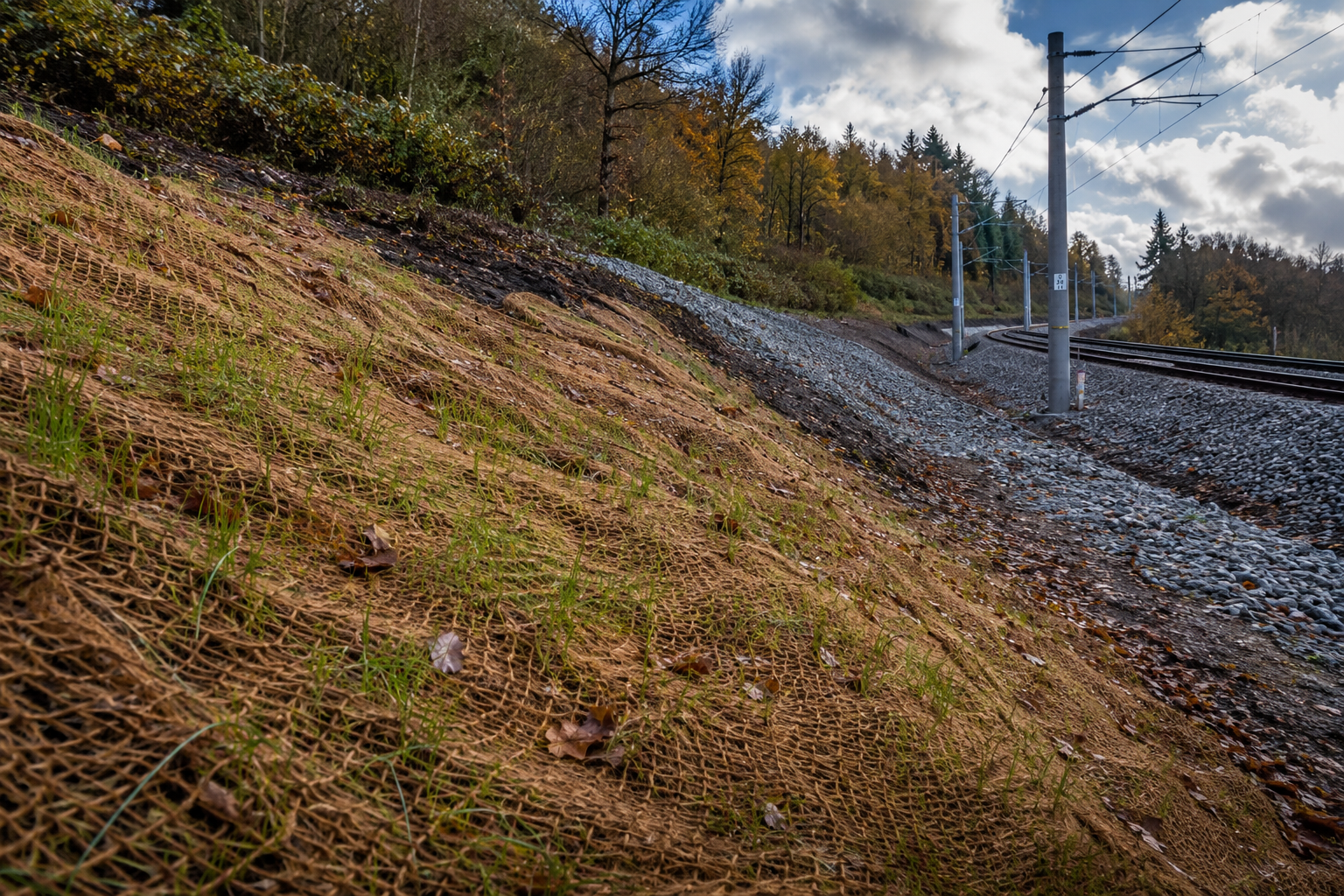
* Coir erosion-control blankets,
* Coir netting
* Coir-based vegetated stabilisation products
Are commonly used to provide temporary surface protection while supporting vegetation establishment during early growth stages.
Within these applications, biodegradability is often considered as part of the intended functional lifecycle of the system, particularly where long-term stability is expected to transition gradually from temporary surface protection toward established vegetation and root reinforcement.
Industry discussion in this area increasingly includes considerations relating to:
* Embodied carbon,
* Material sourcing,
* Disposal impacts,
* Microplastic persistence,
* Maintenance requirements,
* Long-term environmental compatibility.
At the same time, infrastructure professionals continue to recognise that material selection remains highly dependent upon:
* Hydraulic conditions,
* Slope geometry,
* Drainage behaviour,
* Maintenance access,
* Operational requirements,
* Long-term site performance expectations.
Nature-based erosion-control systems are therefore generally considered as part of a broader range of engineering approaches rather than as direct replacements for all conventional stabilisation methods.
As infrastructure sectors continue focusing on resilience, maintenance performance and long-term environmental integration, temporary erosion-control systems are increasingly being discussed within wider conversations around lifecycle infrastructure planning and adaptive engineering approaches.
SALIKE contributes to industry discussion relating to erosion control, slope stabilisation and infrastructure resilience, with a focus on hydraulic behaviour, drainage interaction and long-term landscape performance within civil engineering and environmental infrastructure projects.
Ash
Salike®
email us here
Visit us on social media:
Instagram
Facebook
X
Other
Legal Disclaimer:
EIN Presswire provides this news content "as is" without warranty of any kind. We do not accept any responsibility or liability for the accuracy, content, images, videos, licenses, completeness, legality, or reliability of the information contained in this article. If you have any complaints or copyright issues related to this article, kindly contact the author above.
