

Polyhydroxyalkanoate Market to Reach 367 Kilotons by 2035 as Plastic Bans and Sustainable Packaging Accelerate Demand
Polyhydroxyalkanoate Market (2026 - 2035)
Europe held 40.5% of the Polyhydroxyalkanoate Market in 2025, supported by circular-economy policy leadership.
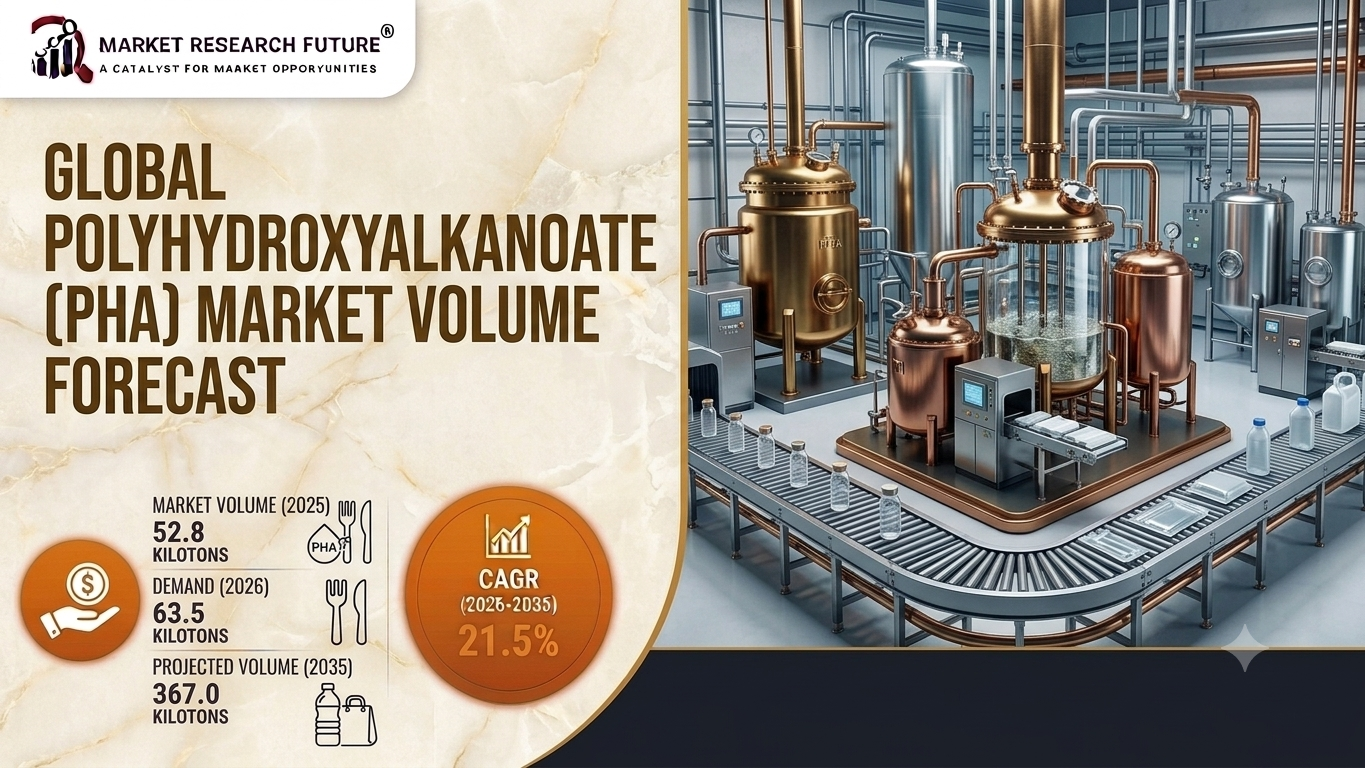
EUROPE, UNITED KINGDOM, August 27, 2026 /EINPresswire.com/ -- The Polyhydroxyalkanoate Market is emerging as an important segment of the global bioplastics industry as manufacturers, brands, and policymakers seek alternatives to conventional petroleum-based plastics. Polyhydroxyalkanoates (PHAs) are biodegradable polymers produced by microorganisms through biological processes and can be used in packaging, agriculture, biomedical products, drug delivery, biofuels, and other applications.According to Market Research Future, the global Polyhydroxyalkanoate Market recorded a volume of 52.8 kilotons in 2025 and is projected to reach approximately 63.5 kilotons in 2026 and 367.0 kilotons by 2035, representing a 21.5% CAGR during the forecast period.
Single-Use Plastic Restrictions Accelerate PHA Adoption
Increasing restrictions on single-use petroleum-based plastics are one of the strongest drivers of the Polyhydroxyalkanoate Market. Governments across major economies are implementing regulations designed to reduce plastic waste, improve recycling, and encourage the adoption of biodegradable or compostable alternatives.
PHA offers an attractive proposition because it can biodegrade under different environmental conditions depending on its composition and formulation. This differentiates it from several conventional plastics that can persist in the environment for extended periods.
Regulatory pressure is encouraging food companies, consumer-goods manufacturers, retailers, and packaging suppliers to evaluate alternative materials. As sustainability requirements become more prominent, PHA can increasingly serve applications where biodegradability and renewable material content are important purchasing considerations.
Packaging Remains the Largest End-User Industry
By end-user industry, the market includes Packaging, Agriculture, Biomedical, and Others. Packaging accounted for 45.2% of the market in 2025, making it the largest end-user segment.
PHA is being evaluated for rigid food containers, flexible packaging, pouches, cosmetic tubes, coffee capsules, and other packaging formats. Its biodegradability and ability to be processed into different product forms make it attractive for companies seeking alternatives to conventional plastic packaging.
Brand sustainability commitments are also supporting demand. Consumer-goods companies are increasingly establishing targets for reducing virgin fossil-based plastic consumption and increasing the use of alternative materials.
Long-term procurement agreements between PHA producers and major brands can also provide greater demand visibility and encourage investment in commercial production capacity.
Get Report Sample Copy with TOC: https://www.marketresearchfuture.com/sample_request/4621
Biomedical Applications Create High-Value Opportunities
Although packaging represents the largest volume opportunity, biomedical applications are among the fastest-growing areas of the market. The biomedical segment is projected to expand at a 23.0% CAGR through 2035.
PHA materials can be engineered for controlled biodegradation, making them attractive for bio-resorbable medical products. Potential applications include sutures, implants, stents, tissue-engineering scaffolds, and drug-delivery systems.
The ability to adjust polymer composition can help researchers develop materials with specific degradation profiles and mechanical characteristics. This flexibility is particularly valuable in medical applications where material behavior must correspond to the healing or treatment timeline.
However, medical-grade applications face lengthy regulatory and clinical-development processes. Producers therefore need to combine polymer innovation with rigorous testing, quality control, and regulatory compliance.
Copolymers Hold a Leading Position
By product type, the Polyhydroxyalkanoate Market is segmented into Copolymers, Monomers, Terpolymers, and Others. Copolymers accounted for 56.3% of market share in 2025, making them the leading product category.
Copolymers such as PHBV can overcome some of the brittleness and narrow processing characteristics associated with certain PHA homopolymers. By adjusting monomer composition, manufacturers can modify flexibility, elongation, crystallization behavior, and degradation characteristics.
This adaptability allows copolymers to serve a wider range of packaging and industrial applications. Their compatibility with established processing technologies also supports their commercial adoption.
Terpolymers are projected to advance at a 22.1% CAGR, supported by demand for specialized thermal and mechanical characteristics in medical and packaging applications.
Sugar and Molasses Remain Important Feedstocks
The market is segmented by feedstock into Sugar/Molasses, Plant Oils & Fatty Acids, Waste Oils, and Others.
Sugar and molasses represented 52.1% of the market in 2025, supported by established supply chains and predictable fermentation performance.
These feedstocks have historically been important because microorganisms can efficiently convert available carbon sources into PHA. However, reliance on refined agricultural feedstocks can expose producers to commodity-price volatility and concerns surrounding food-versus-material competition.
Consequently, producers are increasingly investigating alternative carbon sources that can reduce costs while improving sustainability.
Purchase Now: https://www.marketresearchfuture.com/checkout?currency=one_user-USD&report_id=4621
Waste Oils Gain Momentum
Waste oils are expected to register the fastest feedstock growth, with a 22.2% CAGR through 2035.
Used cooking oil, tall oil, and other waste-based lipid streams can provide alternative carbon sources for PHA production. Their utilization supports circular-economy principles by converting waste materials into valuable polymer feedstocks.
Waste-oil-based production can also help manufacturers reduce dependence on refined sugars and potentially lower raw-material costs. As collection systems improve, waste-derived feedstocks could become increasingly important for commercial PHA manufacturing.
Agricultural residues, wastewater-derived carbon sources, and food-processing waste are also being investigated as potential feedstocks.
Bacterial Fermentation Dominates Production
By production method, the market is categorized into Bacterial Fermentation, Mixed Microbial Culture, and Others.
Bacterial fermentation accounted for 71.5% of the market in 2025, reflecting its established production infrastructure and commercial track record.
Microorganisms such as Cupriavidus necator and Halomonas species can accumulate PHA within their cells when supplied with suitable carbon sources. The polymer is subsequently recovered and processed into resin.
The established nature of bacterial fermentation makes it an important foundation for commercial-scale production. However, manufacturers are exploring new fermentation approaches that can reduce sterilization requirements, improve yields, and accept lower-cost feedstocks.
Mixed Microbial Culture Improves Cost Potential
Mixed Microbial Culture is attracting increasing attention because it can potentially operate with less stringent sterilization requirements and utilize waste-derived feedstocks.
The segment is forecast to grow at a 22.9% CAGR from 2026 to 2035, reflecting its potential to reduce production costs and support circular production models.
Mixed microbial systems use naturally selected microbial communities capable of converting organic waste streams into PHA. This approach can help connect wastewater treatment, food waste management, and polymer manufacturing.
Commercial development of these processes could be particularly valuable in regions where waste feedstocks are abundant but conventional PHA production remains expensive.
Fermentation Technology Becomes a Key Innovation Area
Technological advancement is central to the future development of the PHA industry. Traditional batch fermentation can involve high operating costs, significant energy requirements, and expensive downstream processing.
Continuous-flow fermentation, halophilic microorganisms, and mixed microbial cultures are being investigated as ways to improve productivity and reduce production expenses.
Process digitalization is another emerging opportunity. Sensors, real-time monitoring, predictive analytics, and artificial intelligence can help producers optimize nutrient feeding, fermentation conditions, and microbial growth.
Greater process control can improve yield consistency while reducing batch variability and resource consumption.
Report Summary: https://www.marketresearchfuture.com/reports/polyhydroxyalkanoate-market-4621
Agriculture Offers Another Major Application
Agriculture represents another important application for PHA materials. Biodegradable mulch films are receiving attention because conventional polyethylene mulch can create significant agricultural plastic waste.
PHA-based mulch films can provide temporary protection for crops before degrading after use under suitable environmental conditions. This can reduce the need to collect and dispose of conventional plastic films.
Controlled-release agricultural products and biodegradable coatings also represent potential opportunities.
As governments and agricultural producers seek to reduce plastic accumulation in soil, biodegradable polymers could gain greater acceptance in farming applications.
Marine-Degradable Packaging Creates New Opportunities
Marine pollution is creating demand for packaging materials capable of degrading in aquatic environments. Coastal economies and island nations are particularly interested in solutions that can reduce persistent plastic waste.
PHA's biodegradation characteristics provide an opportunity for applications where conventional compostability may not be sufficient.
Marine-degradable packaging could become a specialized high-value segment, particularly for food-service products, fishing-related applications, tourism, and coastal consumer markets.
Production Cost Remains a Major Challenge
Despite its environmental advantages, PHA continues to face a significant cost disadvantage compared with commodity plastics.
According to the MRFR report, PHA resin prices were approximately USD 4.00–6.50/kg in 2024, compared with approximately USD 1.00–1.30/kg for polyethylene and USD 1.50–2.00/kg for PLA.
This cost gap limits adoption in highly price-sensitive packaging markets. Producers therefore need to improve fermentation yields, reduce feedstock costs, optimize downstream recovery, and achieve greater economies of scale.
Technology improvements and the use of low-cost waste feedstocks are expected to play important roles in narrowing the cost gap.
Processing Infrastructure Needs Further Development
PHA processing can require equipment and operating conditions adapted to the polymer's specific thermal characteristics. Converters may need to modify extrusion, injection-molding, and thermoforming equipment.
This creates an infrastructure challenge, particularly in developing markets where specialized processing capabilities may be limited.
As commercial PHA volumes increase, greater availability of compatible processing equipment and technical expertise should make it easier for converters to adopt the material.
Europe Leads the Global Market
Europe held approximately 40.5% of the Polyhydroxyalkanoate Market in 2025, making it the leading regional market.
The region benefits from strong circular-economy policies, Extended Producer Responsibility frameworks, sustainability initiatives, and established waste-management infrastructure.
Regulatory requirements are encouraging brand owners to investigate biodegradable and compostable alternatives, while European companies are investing in bioplastics research, processing, and commercial production.
Asia-Pacific is the fastest-growing regional market, with a projected 22.5% CAGR through 2035. China and India are important contributors because of their large packaging markets, increasing restrictions on single-use plastics, and expanding bioplastics production capabilities.
North America represents another significant market, supported by venture-backed PHA companies, sustainable-material initiatives, and increasing interest in biomedical applications.
Competitive Landscape
The global Polyhydroxyalkanoate Market includes companies such as Danimer Scientific, Kaneka Corporation, CJ CheilJedang, TianAn Biologic Materials, Newlight Technologies, and PHB Industrial S.A.
Competition is increasingly focused on production scalability, feedstock flexibility, polymer performance, cost reduction, application development, and sustainability credentials.
Companies are investing in fermentation technologies, commercial production capacity, new polymer grades, and partnerships with packaging manufacturers and consumer brands.
Strategic offtake agreements are also becoming important because they can provide producers with demand visibility while helping brand owners secure supplies of emerging bioplastic materials.
Related Report
Polyhydroxy butyrate Market https://www.marketresearchfuture.com/reports/polyhydroxybutyrate-market-4017
US Polyhydroxybutyrate market https://www.marketresearchfuture.com/reports/us-polyhydroxybutyrate-market-20619
polyhydroxybutyrate co hydroxyvalerate market https://www.marketresearchfuture.com/reports/polyhydroxybutyrate-co-hydroxyvalerate-market-29510
US Polyhydroxyalkanoate market https://www.marketresearchfuture.com/reports/us-polyhydroxyalkanoate-market-20410
Market Research Future
Market Research Future
+1 855-661-4441
email us here
Legal Disclaimer:
EIN Presswire provides this news content "as is" without warranty of any kind. We do not accept any responsibility or liability for the accuracy, content, images, videos, licenses, completeness, legality, or reliability of the information contained in this article. If you have any complaints or copyright issues related to this article, kindly contact the author above.
